Menu
Services

The work, from bang to brand new

Most of our week is Mayfield's original doors: tilt and roller mechanisms decades past design life, on detached garages down the drive or off the lane. Repairs run as a call-out, then the fix is quoted on site. New doors start with a free measure and quote. No job is priced sight-unseen, because old garages don't allow it honestly.

Broken springs and cables

If there was a loud bang from the garage and now the door won't lift, that's almost always a snapped torsion spring. Don't try to lift the door by hand; without its counterbalance an old door is brutally heavy, and a snapped spring is exactly the moment fingers get hurt. A spring under tension is also not a DIY part, and we won't pretend otherwise.

We replace torsion and extension springs and frayed or snapped lift cables, and on the old two-spring doors we'll tell you plainly if the second spring is about to follow the first. Around Mayfield the springs we take down are often originals that have quietly done double their expected cycles.
Off-track doors and general repairs

A door that's jumped its track, grinds along one side, or has simply gone heavy is telling you something specific: worn rollers, a bent track, or a timber frame that has moved under it. On interwar garages the frame is part of the diagnosis, not just the door, and that's the difference between a repair that lasts and one that's back in a month.

We re-rail doors, replace rollers and hinges, straighten or replace track, and rebalance doors so one hand can lift them the way they were built to lift.

Openers, motors and remotes

Openers that hum but don't drive, doors that reverse for no visible reason (usually a safety-beam fault), remotes that won't program, and the popular Mayfield special: fitting a modern opener to a door and frame from the 1930s. It can often be done, but the door has to be balanced and sound first; an opener bolted to a worn-out door just wears out faster and hides the fault.

We repair and replace rail-drive openers on sectional and tilt doors and tubular motors in roller doors, set up remotes and keypads, and fit battery-backup and smart modules where they genuinely help. Where a new opener needs mains wiring, that part of the job is done by a licensed electrician, as the law requires.

New doors: sectional, roller and tilt

The considered job, and the one that deserves the most honesty. A new sectional door typically wants roughly 300 to 400 mm of headroom above the opening; a roller door can typically live in about 200 to 250 mm; a tilt door swings outward as it opens. Mayfield's original openings are often narrower, lower and less square than any of those assume, which is why every new door here starts with a measure, not a catalogue.

We supply and install the major Australian-made door types and work on most major door and opener brands. On a leadlight-and-weatherboard street we'll talk honestly about profile and colour so the new door belongs to the house; colour ranges like Colorbond can be matched to the rest of the place as part of the quote (an on-site match is offered as a process, never guaranteed to the millimetre of a weathered fence).

Tune-ups, rebalances and seals

The cheapest garage door work is the kind done before the bang. A tune-up re-tensions the spring, lubricates rollers and hinges, checks cables for fray, rebalances the door and replaces the bottom seal that keeps water, draughts and vermin out. On lane-facing slabs the bottom rail cops the weather worst; a seal and a rust check there buys years.

If your door has gone heavy or started talking to you, a service call now is usually the difference between this page and the springs section above.

Lane-side doors and security

A good share of Mayfield's garages open onto the rear lane, and a lane door is a second front door that nobody watches. The honest conversation is locking: a door that actually shuts square in its frame, locks that lock, and openers that auto-lock rather than relying on a latch that rusted loose years ago.

We square up lane doors, fit and service locks, and set up openers so the lane side of the block is as deliberate as the street side.

Workshop and light-industrial roller doors

Industry is still next door: the Mayfield West and Mayfield North precincts and the port keep real workshops working. We service and replace light-industrial roller doors and shutters at workshop scale, the same honest way: inspect, quote, fix. If your roller shutter is beyond our scale we'll say so rather than learn on your time.

How pricing works, in words

No numbers online, on purpose

Repairs run as a call-out: a technician inspects the mechanism on site and quotes the fix before doing it. New doors run as a free measure and quote: the opening gets measured, the access checked, and the quote is fixed from what the tape says. We don't publish prices because Mayfield's garages genuinely don't allow honest ones sight-unseen; a 1920s opening can double the story a brochure tells.

Ask about your door
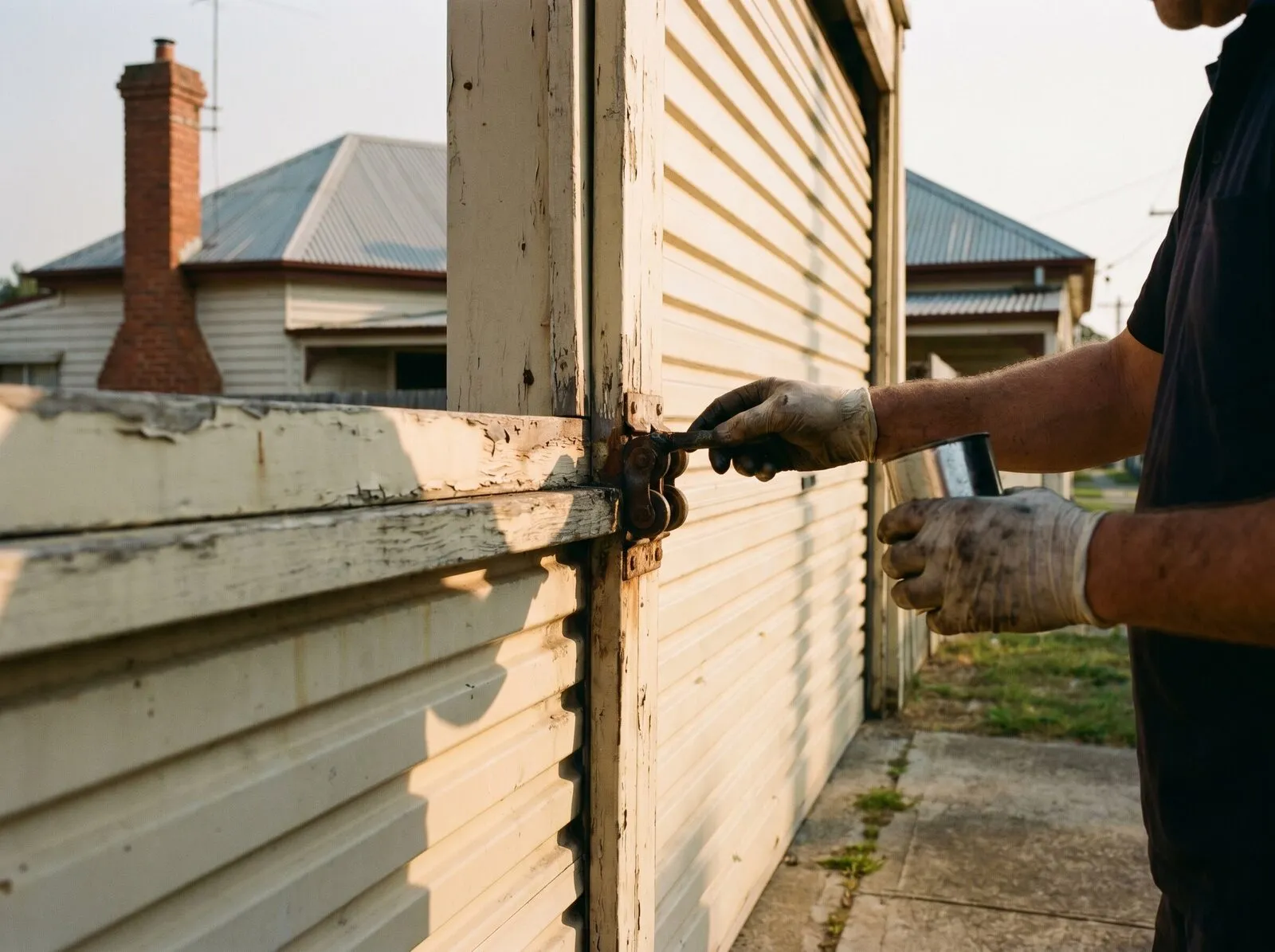
A technician's hands lubricating the rollers and hinge line of an ageing sectional garage door
Most doors want maintenance long before they want replacement.
One form, two kinds of job

Tell us about the door

Broken this morning or being planned for next spring, it starts the same way: a few lines about the door and the block, and a straight answer back.